The Expectation Trap: Why Understanding Perception Matters More Than Ever

There's a quote (nay, equation) that's been rattling around in my brain for years: happiness equals reality minus expectations.
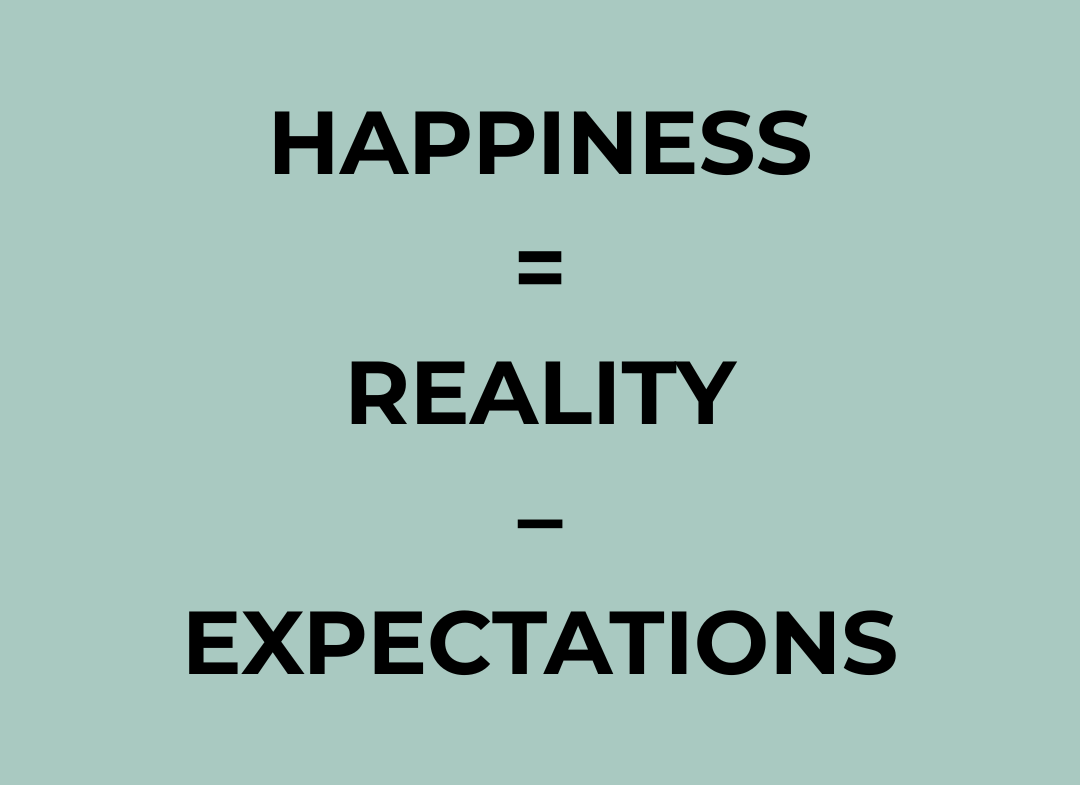
It's one of those deceptively simple equations that feels obvious until you actually live it. And right now, it feels like the expectation gap is quietly fueling much of the division, frustration, and confusion I see everywhere—in relationships, in communities, and nearly everywhere else I look in this country.
This thought bubbled up for me again after a recent podcast episode (Apple, Spotify) where Skippy and I dug into Morgan Housel's reflections on Levittown—the "American Dream" suburb that sprang up after WWII. When soldiers came home to a booming U.S. economy and newfound peace, Levittown offered what people craved most: space, simplicity, and a fresh start.1
The houses were about 700 square feet, no air conditioning, no garages, barely a backyard to speak of. And people loved them. These small, simple homes represented utopia after the Depression and wartime deprivation. (below is an aerial view of Levittown, Pennsylvania c. 1959 I grabbed from Wikipedia)
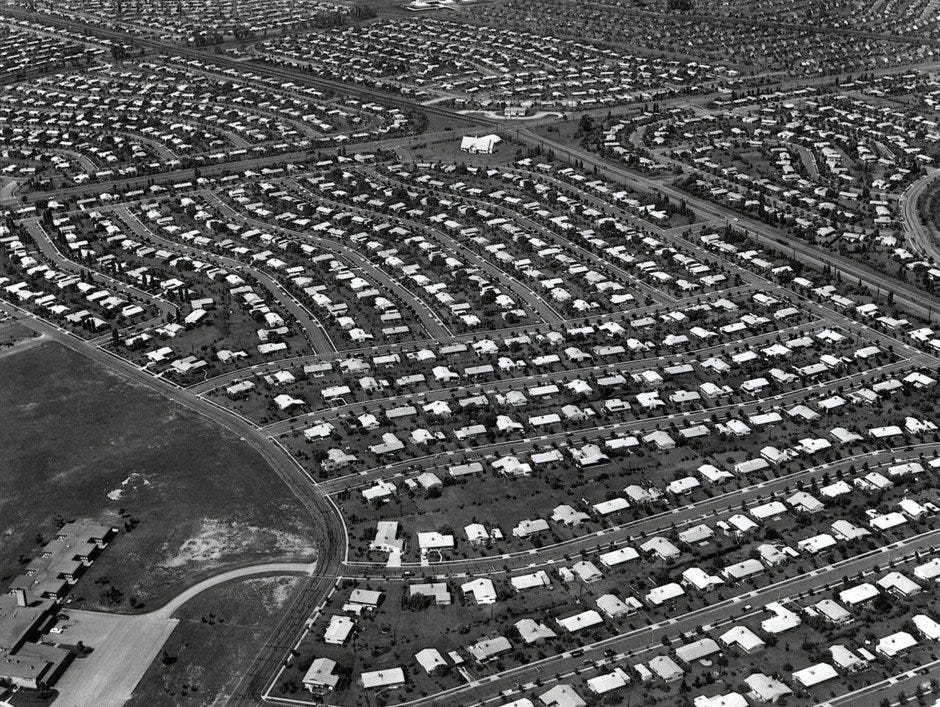
Fast forward to today, and the average American home has tripled in size. We have central air, granite countertops, multi-car garages... and yet, complaints about declining living standards and "how things used to be" echo louder than ever.2
What's changed? Not the raw reality—the facts—but rather our expectations.
The Expanding Gap
Morgan Housel nails this idea over and over in his writing: people tend to remember the feeling of an era, not the reality of it. The post-war years felt full of hope and possibility3—and so we've enshrined them in our collective memory as a "better time." Never mind that the material standard of living, for most Americans, was lower than today. The feeling matters more than the fact.
In An Immense World, Ed Yong dives into a related idea from a different angle: perception itself is wildly subjective. Animals live in completely different sensory worlds based on what they can see, hear, smell, or touch. A bat's reality is all sonar; a shark's is electrical impulses. Even two humans, sitting side by side, can "see" the same sentence and walk away with totally different understandings, shaped by their histories, biases, and memories.
And when our expectations—about each other, about society, about life—don't match up with reality (or with someone else's reality)? Frustration, blame, and alienation creep in.
The State of Disagreement
The United States feels especially fractured right now — politically, culturally, economically…you pick your poison. And beneath many of these fractures sits the quieter truth that we’re living in radically different expectation worlds.
One group expects life to "go back" to how they perceived it was in the past (even if that past never existed in the way they remember). Another expects relentless progress, where each generation lives better than the last. Another expects radical reinvention, scorched earth and all. Another expects safety and stability above all. It goes on and on and on.
None of these groups are “wrong” per se. They're just holding different expectations born from different lived experiences, different inputs, and different sensory realities.
The real tragedy isn’t that we disagree. It’s that we assume we’re disagreeing about facts, when often we’re really disagreeing about expectations and perceptions.
You can’t argue someone out of their experience of the world any more than you can argue a bat into seeing color. And yet, every day, we try.
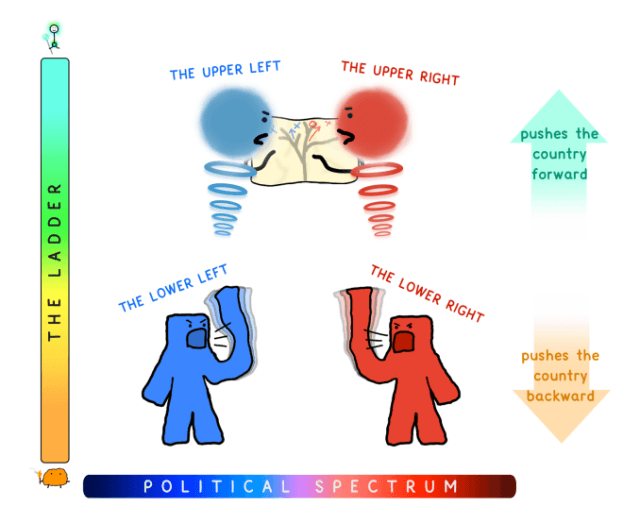
The image below is from Tim Urban’s book “What’s Our Problem,” and captures the concept quite well.4
What This Means For Us
So what do we do with all this? Are we doomed to yell across perception chasms forever?
I don’t think so. But it does require a shift.
First, we have to start from a place of humility. You are never seeing the full picture. Neither am I. Neither is anyone. No matter how rational, educated, or "right" you feel—you are operating inside a bubble created by your past, your biology, and your expectations.
Second, we have to become relentless about asking questions instead of making assumptions. When someone sees the world differently than you, the most useful question isn’t "how can I convince them they're wrong?" but "what must their world look like for that view to make sense?"
Third, and perhaps most importantly, we have to manage our own expectations—both of ourselves and of others. If your happiness really is reality minus expectations, then managing your expectations isn’t defeatism. It’s self-preservation.
Manage expectations that your friends will agree with you on everything. Manage expectations that the country will suddenly become unified and harmonious. Manage expectations that your job, your relationships, your investments, your everything will move linearly upward forever.
In other words, expect complexity. Expect struggle. Expect people to see and feel things differently.
And in doing so, the goal is to replace resentment with curiosity, frustration with resilience, and cynicism with occasional delight.
We can choose to see expectations for what they are: human-made stories. We can choose to notice the gap between expectation and reality, and instead of blaming ourselves or each other, simply adjust.
It ain’t easy. But in a world that seems more fractured every day, taking steps like this might just be the thing that stitches us back together.
I know that the living standard complaints are not just about (and not primarily about) housing, but this is illustrative.
This was not true of all Americans btw…I’m capturing a general spirit of the era, not the reality for many, especially in marginalized communities.
What’s Our Problem By Tim Urban is another good book worth reading related to this topic is